
Article
Kafka tiered storage deep dive
Explore Apache Kafka's tiered storage feature, which helps scale compute and storage resources independently and provides better client isolation.
Explore Apache Kafka's tiered storage feature, which helps scale compute and storage resources independently and provides better client isolation.

In this blog, we focus on Templates, TemplateInstance (TI), and TemplateGroupInstance (TGI) in the Multi Tenant operator, officially certified with Red Hat.

Learn how teams can boost developer productivity by implementing Red Hat Developer Hub to automate repetitive tasks and introduce self-service options.

Learn how to install a Red Hat Data Grid server using Data Grid Helm charts, which offer more flexible deployment and resource management.

Get an overview of kube-burner, a flexible open source Kubernetes performance and scale testing tool, and explore the latest features and usability improvements.
The Developer Sandbox is a great platform for learning and experimenting with

While learning about state-of-the-art software development is important and

Check out the winning projects from the CodeShift hackathon, showcasing the Red Hat OpenShift application development platform and Intel’s AI/ML technologies.


VMware Cloud Foundation 5.1 now supports Red Hat OpenShift Container Platform 4.13 and NVIDIA AI Enterprise, offering automated, consistent infrastructure and more.
Learn best practices for estimating resource requirements when planning an OpenShift Data Foundation disaster recovery environment.

Podman Desktop has been awarded the 2024 DEVIES Award for Best Innovation in
Get an overview of key security best practices for Red Hat OpenShift Dev Spaces that can help foster a more resilient development environment.
The Palo Alto Networks’ CN-Series Container Next-Generation Firewall product now supports the OVN-Kubernetes CNI plug-in on Red Hat OpenShift clusters.
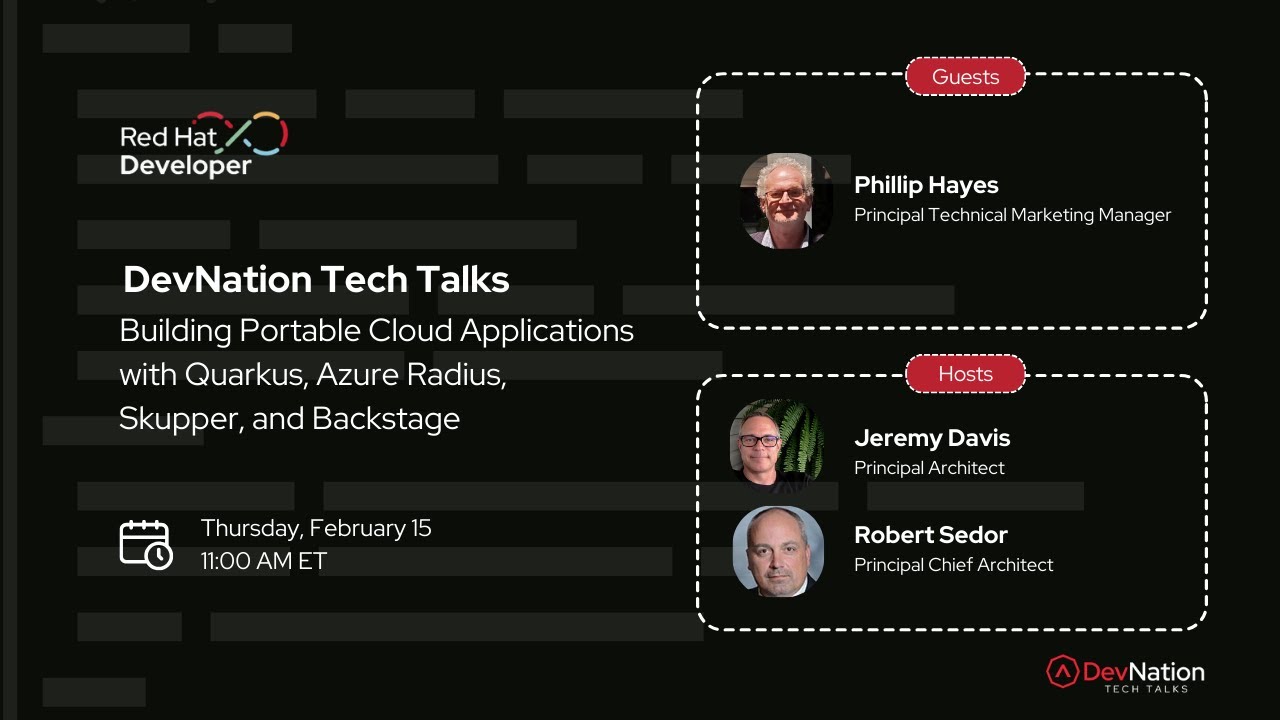
DevNation Tech Talk: Building portable cloud applications with Quarkus, Azure Radius, Skupper, and Backstage
Explore 3 core features of Stakater's Multi-Tenant Operator—Quotas, Tenants, and Console—and how they help enforce efficient and secure multi-tenancy.

Learn how to use an external database with Quarkus and link an example application to an external Microsoft SQL Server database in this tutorial.

You can build and populate a database that is running in Red Hat OpenShift in a

Without data, software has no value. Data needs to be created, stored, updated

Red Hat OpenShift is a Kubernetes distribution that makes it easy to deploy and
Learn how to provide granular access in Red Hat OpenShift Dev Spaces and manage functionality for specific users in this quick tutorial.
Learn how to deploy Meteor.js applications to Red Hat OpenShift, which offers a great developer experience for running JavaScript applications at scale.
Learn how to deploy Next.js applications to Red Hat OpenShift, which offers a great developer experience for running JavaScript applications at scale.
Ready to start developing Kubernetes Operators? This guide breaks down the essential components you'll need to get started.

Explore cloud-native blue/green deployment strategy using Argo Rollouts following a GitOps model in this demonstration.

Build here. Go anywhere.
We serve the builders. The problem solvers who create careers with code.
Join us if you’re a developer, software engineer, web designer, front-end designer, UX designer, computer scientist, architect, tester, product manager, project manager or team lead.