
Video
Offline CLI with JBoss EAP 7 Video
Understanding and getting started with EAP 7's new Management CLI option for offline management of your JBoss EAP server.
Check out popular resources, tools, and information from Red Hat. We'll recommend more as you browse.
A subscription may be required for some services.
Understanding and getting started with EAP 7's new Management CLI option for offline management of your JBoss EAP server.

This video shows how to get started with developing Java EE application using JBoss Developer Studio 10 and JBoss EAP 7

Watch this demo to see how Red Hat JBoss Data Grid provides fast, in-memory access to data and elastic scale to your application. Learn how you can achieve fault tolerance and resiliency when multiple copies of data are distributed across the grid and automatically backed up to other datacenters. JBoss Data Grid allows you to scale, boost application performance, and quickly recover from a disaster scenario.

The first step in understanding JBoss BRMS is provided in the JBoss BRMS Starter Kit. A crucial piece of the puzzle is the very easy install project that gets you up and running quickly. This video shows where to find this project, how to obtain it and how to set it up.

Here is a quick guide on how to get started with the latest ALPHA release. http://blog.eisele.net/2015/11/getting-started-with-eap-7-alpha-and.html

Demonstrates the features of the JBoss Fuse SAP Tool Suite preview.
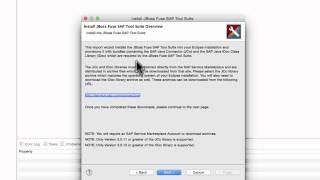
Step by step guide to installing the JBoss Fuse SAP Tool Suite

Slides from the presentation available at: http://www.slideshare.net/hekonsek/io-t-gateway-dream-team-eclipse-kura-and-apache-camel Eclipse Kura is the well recognized field gateway for Internet Of Things applications. Apache Camel is the message routing engine and the library containing a gazillions of the various endpoint connectors. Are you interested in finding out how these two can be joined together to create a rocking IoT solution? Then tune in to this talk by +Henryk Konsek, Engineer at Red Hat.

Devoxx4Kids Day at JavaOne 2014 Teaser Many thanks to Bert Breeman for creating the video!

jkazda@gmail.com

Database Migrations with Flyway - Java EE Hanginar

The Red Hat JBoss Unified Push server allows developers to send native push messages to Apple's Push Notification Service (APNS) and Google's Cloud Messaging (GCM). It features a built-in administration console that makes it easy for developers to create and manage push related aspects of their applications for any mobile development environment. Includes client SDKs (iOS, Android, & Cordova), and a REST based sender service with an available Java sender library

Develop a push enabled Cordova application using Aerogear push server, Openshift and JBoss developer studio Openshift: https://www.openshift.com/ Aerogear examples: https://github.com/aerogear/aerogear-push-quickstarts/ JBoss Developer Studio: http://tools.jboss.org/ Cordova: http://cordova.apache.org/

A JUDCon 2012 session presented by Tom Cunningham and Keith Babo In this session, Tom and Keith will cover the state of the ESB at JBoss as represented in two community projects - JBoss ESB and SwitchYard. While JBoss ESB is the current foundation of JBoss SOA Platform, the next major version of the platform will use SwitchYard at its core. So what are the differences between these two projects, why are we making this change, and how will it impact JBoss users and developers? This session covers all that and more: • Past, present and future of JBoss ESB and SwitchYard • Similarities and differences between the projects • Detailed walkthrough of migration strategies for existing ESB applications • Practical tips for service development on both platforms If you're interested in ESBs in general or the JBoss-flavored ones in particular, come join the project leads for JBoss ESB and SwitchYard for this informative session. There will be straight talk, expert advice, loads of examples, interactive discussion, and dancing bears.
Automation to enable the business user. Many organizations have embedded key policies and practices deeply within IT applications making it difficult, if not impossible, for the business user to make changes. This video describes how JBoss Enterprise BRMS separates business rules from the application code, allowing business users to easily make updates in real-time, with fewer errors.

"We've been running mission-critical applications on Red Hat Enterprise Linux for a long time. It was that experience and those results that led us to consider JBoss Enterprise Middleware, and we're satisfied--and not surprised--knowing that Red Hat's middleware solutions are as enterprise-class as its platform solutions." - Brian Clark, chief software architect, NYSE Euronext Find out more at: http://customers.redhat.com/2010/06/19/nyse-euronext-standardizes-on-jboss/?intcmp=70160000000IgpeAAC

Jason Andersen, Product Line Director for Application Platforms, describes the architecture of the JBoss Enterprise Portal Platform, a portal product typically used for external , self-service websites.

Heidelberg's Global IT Director Mathias Berg explains how, with the help of Red Hat(R) Consulting, Heidelberg built an interactive customer portal using JBoss(R) Enterprise Portal Platform and migrated its proprietary application platform to JBoss Enterprise Application Platform. Find more Red Hat and JBoss customer success stories: http://www.redhat.com/customersuccess/

Is your SOA solution simple to develop, deploy, and manage? JBoss Enterprise SOA Platform is, and here are a few of the reasons why. Want more information about JBoss SOA? http://www.jboss.com/resources/soa/ http://www.jboss.com/products/platforms/soa/

With JBoss, your SOA solution comes from a large, open developer community. When your needs change, we listen. It's SOA built for your needs. Not ours. And that means you're in control. Find out more about JBoss SOA: http://www.jboss.com/resources/soa/ http://www.jboss.com/products/platforms/soa/

In this keynote talk from JBoss World 2012, Craig Muzilla, vice president and general manager of the Middleware Business Unit, and Dr. Mark Little, senior director of Middleware Engineering, both from Red Hat, demonstrate how JBoss Enterprise Middleware transcended its beginnings as a rock-solid application infrastructure to become a strategic asset for enterprises to significantly improve their businesses. They also discuss how Red Hat is attacking the challenges customers are facing today as they consider their next-generation enterprise architectures. Fast, easy-to-use, high-value application infrastructure is critical to enterprise success. But it's not enough. Today, IT is expected to not only cut costs, but also drive top-line revenue by optimizing business process flow, extending beyond the traditional datacenter to incorporate mobile devices into enterprise solutions and efficiently exploit terabytes of data. The way we develop and integrate applications, design enterprise architectures, and leverage new technologies, including NoSQL, elastic data caching, and even industry standards such as Java, must evolve to deliver on the promise of cloud an mobile. Little and Muzilla show how Red Hat is at the heart of it all, driving the technologies, standards, and software platforms that enable customers to prosper. Watch more 2012 Red Hat Summit and JBoss World videos: http://www.youtube.com/playlist?list=PL995CD1141C3330D5&feature=plcp

A JUDCon 2012 session presented by Paul Bakker Designing a system that can evolve without creating a maintenance nightmare is far from trivial and there are no silver bullets to do this correctly. A service oriented, modular architecture will help a lot to achieve this goal. Modularity forces separation of concerns which, when combined with a service oriented architecture, enables you to replace parts of a system without breaking others. The only mature modularity approach for Java is OSGi. OSGi is a framework that enables low-level modularity and services, but it is not an application framework like Java EE, i.e. you still need APIs to create web applications, use transactions, access data sources etc. Without these APIs you will have a hard time to actually build applications. Unfortunately OSGi and Java EE did not interoperate well in the past; it was very challenging to mix both. But what if we want modularity in our architecture, but also the ease-of-use of Java EE 6? Luckily times are changing. All major application servers are getting support for deploying mixed Java EE and OSGi applications. This makes it possible to deploy OSGi bundles that contain Java EE 6 code such as EJBs, JPA and JAX-RS resources. CDI can be used to inject OSGi services and EJBs can easily be exported as OSGi services too. The next question is how to deploy this into the cloud. Just uploading a large WAR file to a server in the cloud doesn't fit modularity very well. How can you update just parts of a running application without breaking the rest of it? We will introduce Apache ACE, an Open Source Provisioning Platform to deploy OSGi bundles (containing Java EE code) and other artifacts to the cloud.
A JUDCon 2012 session presented by Matt Hicks. Join us for a technical how-to session on how to develop iPhone and Android apps with MongoDB backends for the cloud. Let's skip having to learn three different languages and jumpstart the development process using what you already know. We'll utilize Titanium to create a native mobile application targeting multiple mobile platforms. Next, we'll deploy our backend app to the cloud using JBoss AS and hook it up to our mobile app via a REST API. Finally we'll pull out our smartphones and bask in the awesomeness of our apps! Nothing complicated, nothing convoluted. Just straight ahead mobile development goodness with JBoss and MongoDB.

Paul Daugherty, chief technology architect at Accenture, gives a keynote talk at the 2011 Red Hat Summit and JBossWorld. Daugherty speaks about Accenture's work as a leading technology and systems integration outsourcing firm, with more than 6,000 people working in areas of open source development and deployment. In order to deliver high-performance capabilities, Accenture considers open source a key component. Accenture has continued to see a rise in open source adoption and expansion because of better quality, security, flexibility, and opportunity delivered by companies like Accenture and its partners (including Red Hat). These alliances work hard with their customers to create ever-improving innovative business solutions. Daugherty also discusses trends and shifts in the technology industry, including cloud computing, data, analytics, and architectures, and examines how today's computing is service-centric instead of server-centric. These developments only heighten the importance of security and access control. He also touches on the usefulness and necessity of social media and platforms--another method by which companies can listen and understand what customers like best, and need most. See more videos from the 2011 Red Hat Summit and JBossWorld: http://www.youtube.com/user/RedHatVideos#g/c/995CD1141C33

Enterprises must deal with an exploding number of the business events and data associated with them. Too often, supporting IT infrastructure is not integrated, flexible, nor adaptable to constantly changing business conditions. This results in slow and poor-quality responses, products, and services to customers.

Build here. Go anywhere.
We serve the builders. The problem solvers who create careers with code.
Join us if you’re a developer, software engineer, web designer, front-end designer, UX designer, computer scientist, architect, tester, product manager, project manager or team lead.
 Ask AI