
Article
Using Red Hat Application Migration Toolkit to see the impact of migrating to OpenJDK
How to use Red Hat Application Migration Toolkit to analyze you codebase to understand the impact of migrating to OpenJDK.
How to use Red Hat Application Migration Toolkit to analyze you codebase to understand the impact of migrating to OpenJDK.

The Red Hat Fuse Tooling team created a new Yeoman-based Camel-Project generator for developers to jump start their Camel development in any IDE where Yeoman is supported. How to install and run the generator is shown.

The final article in this 4 part series covers Eclipse Che 7 features to help enterprise development teams and discusses release timing.

Part 3 of 4 covering Eclipse Che 7 features. With a new workspaces model and full “dev-mode” for application runtimes—Eclipse Che the first kube-native IDE!

Part 2 of 4 articles on upcoming features in Eclipse Che 7. This article provides a deep dive on the new plugin model of Eclipse Che 7 and VSCode compatible extensions.
Part 1 of 4 articles on Eclipse Che 7 featuring a better plugin model, a new IDE, and Kubenative Workspaces — Eclipse Che Is on Fire !

This article, the second is a series about eXpress Data Path (XDP), explores maps--a more-advanced eBPF feature--and some common pitfalls and basic debugging techniques.

Red Hat Container Development Kit (CDK) 3.7 is now available to run an OpenShift/Kubernetes cluster on your laptop for developing cloud- and container-based applications.

CodeReady Workspaces lets teams code with greater security and faster onboarding while eliminating the "It works on my machine" syndrome.
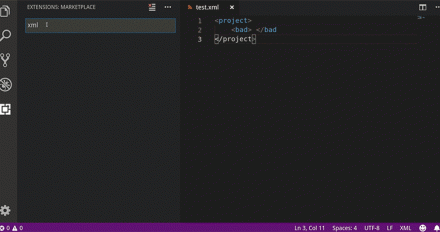
Red Hat XML Extension now available on the VSCode Marketplace with schema-based support. Get syntax highlighting and checking, code completion, document folding, and more.
This article introduces the new Red Hat OpenShift extension for Visual Studio Code. It explains the benefits the extension provides, provides a demo video of using the extension, and covers installation details.

Buildah and Podman allow you to build and run containers without installing and managing a daemon on your system/kubernetes cluster. The relationship between buildah and podman is explained.

Red Hat has recently released Clang/LLVM, Go, and Rust as General Availability. This article covers the support lifecycle and release cadence for these compilers.

Colossal Cave Adventure may be the most influential computer game ever. This article shows you how to find, build, and run its source code.

Free Online Java EE Development Course From Red Hat Available Now via edX. Learn enterprise Java development with JBoss EAP and our Developer Studio IDE.


An overview of Byteman, debug Java by injecting code into methods without the need to recompile, repackage, or even redeploy the application.

This post shows how to install the latest versions of Node.js on RHEL 8 and RHEL 9


Twice a year, Red Hat distributes new versions of compilers,run times, open source databases, and/ web tools providing developers with access to the latest, stable versions on Red Hat Enterprise Linux 7.
Red Hat Software Collections 3.2 beta adds: Node.js 10, PHP 7.2, Varnish Cache 6.0, MySQL 8.0, NGINX 1.14, Git 2.18 to Red Hat Enterprise Linux 7

Red Hat is one of the major contributors to the Eclipse Che community. Learn how Red Hat is participating at EclipseCon Europe.
Red Hat Container Development Kit (CDK) 3.6 is now available to run an OpenShift/Kubernetes cluster on your laptop for developing cloud- and container-based applications.

Red Hat Developer Studio 12.9 and the community edition, JBoss Tools 4.9.0 for Eclipse Photon 2018-09, are now available. This article highlights some of the new features in both JBoss Tools and Eclipse Photon, covering WildFly, Spring Boot, Camel, Maven, and many Java-related improvements—including full Java 10 support.

Build here. Go anywhere.
We serve the builders. The problem solvers who create careers with code.
Join us if you’re a developer, software engineer, web designer, front-end designer, UX designer, computer scientist, architect, tester, product manager, project manager or team lead.
 Ask AI