CDI (Part 1): Introduction to CDI
This presentation provides an introduction to CDI (Contexts and Dependency Injection), covering the basic and intermediate features. It was presented by Antoine Sabot-Durand, the co-spec lead for CDI.
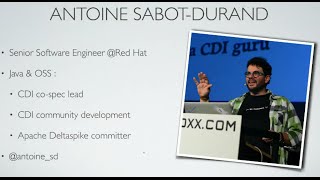
CDI portable extensions are one of greatest features of Java EE allowing the platform to be extended in a clean and portable way. But allowing extension is just part of the story. CDI opens the door to a whole new eco-system for Java EE, but it’s not the role of the specification to create these extensions. Apache DeltaSpike is the project that leads this brand new eco-system by providing useful extension modules for CDI applications as well as tools to ease the creation of new ones. In this session, we’ll start by presenting the DeltaSpike toolbox and show how it helps you to develop for CDI. Then we’ll describe the major extensions included in Deltaspike, including 'configuration', 'scheduling' and 'data'. Speaker Antoine Sabot-Durand is the CDI co-spec lead. He is also the tech lead of the Agorava project.
Ceylon is a new modern, elegant programming language for the JVM and JavaScript VM, designed for team work. But it's more than that, it is a full platform with modularity, an SDK, tools and IDEs. We will present Ceylon the language, the platform, and its ecosystem. You will see everything from starting a new project in the IDE to publishing it on Herd, our module repository, including using the SDK. We will also discuss the ongoing Ceylon projects such as the build system, Vert.x integration or Cayla, the new web framework. Finally we will discuss the plans for Ceylon 1.2 and further.
Looking to design business processes but not sure how to get started? If this is the first you’ve heard of Red Hat JBoss BPM Suite, or you’re anxious to get started with your freshly downloaded JBoss BPM Suite, this webinar’s for you. Have no fear, the JBoss BPM Suite starter kit will: • Provide you with the details, help, and path to rules, events, and process freedom. • Show you a quick and easy entry into the world of process design. • Walk you through the contents, and what you can achieve, with the JBoss BPM Suite. • Start you off with an easy installation. • Use a pre-installed project and workshop to take you step-by-step through constructing the project from scratch. Join us for a grand tour of the JBoss BPM Suite starter kit, and learn how you can hit the ground running as the BPM expert you always wanted to be.
Google App Engine (GAE) is a popular PaaS offering. Where its scalable and reliable environment is hidden behind a custom API. This makes GAE apps hard to port over to other non-GAE environments. But what if one could implement such similar environment? And you could simply move your GAE application’s .war file to this new environment and it would just work? After all, at the end it’s all about the API, plus scalable and reliable services. JBoss CapeDwarf project aims at making this a reality. This presentation will provide a glimpse into what it takes to implement something as GAE, ranging from runtime integration with JBoss Application Server, actual services implementation to last but not least, automated heavy testing.
Join us for this interactive event and get your hands dirty with some WildFly 9 hacking! Our host Kabir Khan will explain how you can contribute to the WildFly project at many different levels, from properly reporting bugs in the forums and issue tracker, to actually being able to submit a pull request. During this interactive event you will have a chance to play with WildFly 9 and try some of the following: • Find a JIRA you want to work on. • See how to check-out the code and setup your IDE. • Build WildFly • Code walkthrough - code organisation, jboss-modules etc. • Debug something from a stack trace in a JIRA issue to nail down the • problem. • Try the testsuite • And more!
In this JBug, Tom will use an example driven format to illustrate some of the new features that have been added into Narayana recently. We will look at: 1. Why you need a transaction manager - a brief revision course 2. Using Narayana inside none-EE containers, mainly focussing on Tomcat 3. The Narayana STM library 4. Narayana and NoSQL
This session covers new improvements that will be introduced in WildFly 9: * Wildfly-core will be extracted from the codebase and the ability to assemble a server on top of it will be introduced. WildFly 9 will be provided in two versions: Wildfly Web and Wildfly Full but users will be able to create their custom packaging of WildFly. * Users will be able to shutdown the application server in a graceful manner - after the shutdown command is executed server will reject new requests and allow existing requests to finish before it shuts down. * Support for HTTP/2, a new version of HTTP protocol based on SPDY, will be introduced. * Users will be able to use WildFly as a load balancer. Consequently, it will be possible to manage the balancer with the same tools that are used to manage the rest of the domain. What is more, users will be able to use more efficient protocols, such as HTTP/2, for communication between the balancer and backend servers. An OpenShift cartdridge, which will enable users to use WildFly 9 in cloud environment, will be provided. WildFly 9 will use OpenJDK ORB library instead of JacORB.
Microservice architectures have become popular, but we have to balance hype with reality. Microservices make it harder to manage deployments and create complex inter-service communications patterns. Learn how Open Source software built by open communities like Apache Camel, Docker, Kubernetes, OpenShift and Fabric8 can help achieve organizational goals to integrate services and establish effective continuous integration and continuous delivery pipelines. With Christian Posta - Principal Middleware Specialist
Today, when microservices are widely used we often need a tool for sending messages throughout the cluster. During the presentation we will learn how to send information between nodes, invoke RPCs or even coordinate distributed task execution. Clustering might be fun!
== Abstract == Scale changes everything. What once was quite adequate for enterprise messaging can't scale to support "Internet of Things". We need new protocols, patterns and architectures to support this new world. This session will start with basic introduction to the concept of Internet of Things. Next it will discuss general technical challenges involved with the concept and explain why it is becoming mainstream now. Now we're ready to start talking about solutions. We will introduce some messaging patterns (like telemetry and command/control) and protocols (such as MQTT and AMQP) used in these scenarios. Finally we will see how Apache ActiveMQ is gearing up for this race. We will show tips for horizontal and vertical scaling of the broker, related projects that can help with deployments and what the future development road map looks like. == Speaker == Martyn Taylor is a senior software engineer at Red Hat, with over 7 years' experience working on cloud, middleware and messaging software. Martyn currently works on the Apache ActiveMQ suite of projects.
The release of the latest JBoss Developer Studio (JBDS) brings with it the questions around how to get started with the various JBoss Integration and BPM product tool sets that are not installed out of the box.
The process can be consistently executed in the same way.