EDI Transformations with Fuse Integration Services (FIS)
Scott McCarty shares how containers can help in the DevOps world, but pay attention to 3 items.
This lightning talk was delivered at Red Hat Summit 2017.
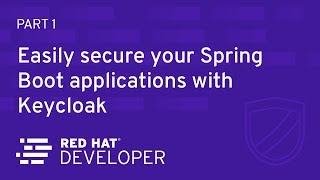
Although security and identity management is a crucial aspect of any application, its implementation can be difficult. Worse, it is often neglected, poorly implemented and intrusive in the code. But lately, Identity Management servers has appeared which allow to outsource and delegate all authentication and authorization aspects. Of these servers, one of the most promising is Keycloak, open-source, flexible and agnostic of any technology, it is easily deployable / adaptable in its own infrastructure. In this session, I propose you to discover KeyCloak progressively and in an interactive way: 0 slide, 100% live coding."
Ryan Hennessy, Sr. Solution Architect, Red Hat and Guna Vijayaratnam, Solutions Architect, Red Hat speak in this breakout session at Red Hat Summit 2017. The Red Hat team had the opportunity to work with a lot of customers, this one, in particular, was struggling with their application deployment process. Their current processes were fragile and didn’t meet the business needs to be more flexible, automated, and cloud-centric. The customer IT department realized if they didn’t address these problems soon there was a high risk that individual business units were going to start looking to other partners for serving their IT needs. In this session, we will cover in depth the following areas: Main hosting focus areas and business drivers that lead to the adoption of OpenShift Application delivery methodologies that were modernized using OpenShift How OpenShift was able to directly solve the challenges and focus areas set out by IT leadership. https://www.redhat.com/en/summit/2017/agenda/sessions
Zohaib Hhan, Practice Lead, Application Modernization & Migration, Red Hat and Malik Sayed, Sr. Manager, Digital Architecture, Verizon speak in this breakout session at the Red Hat Summit 2017. Enterprises generally have a significant portfolio of legacy applications running in production. Applications that have been developed 10, 15 years ago, or more. These applications stand in the critical path of revenue generation. It's not easy to just rip them out and replace them all with applications built on modern architectures, such as microservices and containers. Businesses can't afford downtime and certainly aren't willing to pay for something they can't see. We need the ability to modernize legacy applications while allowing IT to continue to deliver value—innovating from inside out. Verizon evaluated Red Hat OpenShift Container Platform to modernize their application portfolio. In this session, we'll present Verizon’s journey to containerize one of their most challenging applications. We'll show the results of a 2-month long proof-of-concept, including successes, misses, and a roadmap for application modernization. You'll learn about the journey, the pitfalls, and the lessons learned of modernizing complete application portfolios. Learn more: https://www.redhat.com/en/summit/2017/agenda/sessions
James Strachan, sr. consulting software engineer, Red Hat, and James Rawlings, principal software engineer, Red Hat, discuss and demo continuous integration and continuous delivery (CI/CD) in OpenShift.io in this breakout session at Red Hat Summit 2017. James Strachan explains CI/CD and its importance to developing, testing, and releasing code. He then demos how it works in OpenShift.io using Jenkins pipelines. Watch the live demo to see it in action.
Pete Muir, technical director, Red Hat Developer Tools, and Gorkem Ercan, principal software engineer, Red Hat, present this breakout session on cloud workspaces in OpenShift.io at Red Hat Summit 2017. Pete discusses how cloud workspaces work in OpenShift.io and their capabilities. He explains the workspaces, describes how Eclipse Che fits in, and details why Red Hat chose this technology. He also outlines the benefits of running in a container. Gorkem presents a demo of the cloud workspaces, including coding, testing, debugging, and integrating analytics. The session closes with an audience Q&A.
Todd Mancini, lead product manager, Developer Tools, Red Hat, and SriKrishna Paparaju, sr. principal software engineer, Red Hat, talk about OpenShift.io analytics in this breakout session at Red Hat Summit 2017. Todd details the analytics capabilities of OpenShift.io—features available today and what’s coming in the future. With OpenShift.io, developers can take large data sets and infer issues, problems, and concerns to help them make better decisions. SriKrishna provides additional insight into the past, present, and future of Fabric8 and OpenShift.io analytics, including use cases.
Hear from Todd Mancini, lead product manager, Developer Tools, Red Hat, Pete Muir, technical director, Red Hat Developer Tools, and James Stachan, sr. consulting engineer, Red Hat, in this breakout session from Red Hat Summit 2017. The group shares the development journey of OpenShift.io, and the various developer needs considered when creating the product. They give a product demo of OpenShift.io, showing the benefits of developing, testing, and running on the same platform. The breakout session closes with an audience Q&A.
By aligning development and operations teams with solutions from Red Hat Consulting and OpenShift Enterprise by Red Hat, you can: -Reduce product cycle time. -Write applications faster. -Drive automation that strengthens the link between IT and the needs of your organization. This video includes a demonstration of OpenShift Enterprise.
Intro to OpenShift Express (Fedora) - This video demonstrates how to install the OpenShift Express client utilities on the Fedora operating system. Furthermore, it provides a walk through of signing up for an RHN account using the OpenShift website and details steps to allow a user to create their first express domain. Please go to openshift.redhat.com for more details.
Join Red Hat OpenShift developers Krishna Raman and Dan McPherson for an interactive whiteboard, slide, and demo session where they will dive into OpenShift's architecture, internal components, APIs, and security model. If you are a systems architect interested in learning what it takes to build a Platform-as-a-Service (PaaS), this talk is for you. Curious about the code that powers OpenShift and what it takes to run a scalable and secure PaaS? This is the talk for you!
Mike McGrath, a cloud architect at Red Hat, speaks about the OpenShift project, including express--a way to easily on-board PHP, Ruby, and Python applications via standard, open interfaces. McGrath demonstrates the process of uploading and updating the applications in the cloud using express, as well as ways to snapshot, clean up, and remove applications that are being migrated or eliminated. Learn more about Red Hat OpenShift: http://openshift.redhat.com/app/ Learn more about Red Hat cloud technology: http://www.redhat.com/cloud/build/
Come learn about what goes on behind the scenes with Red Hat OpenShift and the implications of having all of a project's operations running entirely in the public cloud. Brett Lentz, senior software engineer at Red Hat, will cover the tools, design patterns, and security considerations that are critical to make operating in the public cloud a success. He will also spend a significant part of the session discussing configuration management and automation techniques as they are key factors for success in the OpenShift environment. Living in the public cloud has significant security implications that will be discussed in depth. Tools and concepts such as SELinux, update lifecycle management, and "SSL/TLS Everywhere" are not just good ideas, but crucial to succeeding in the public cloud. Brett will cover tools and techniques for easing the integration of these and other security tools. Brett will also discuss how identifying powerful, reusable design patterns has allowed the OpenShift team to find efficiencies, enabling it to move at a rapid pace and not just put out fires, but to continually roll out new features and incremental functionality improvements.
Isaac Roth from Red Hat discusses the way developers can use OpenShift flex to self-service deploy applications in minutes, choose and manage operating environments, and share and monitor information and functionality. Watch as Roth demonstrates OpenShift actions, deployments, and measures through the management interface. Learn more about Red Hat OpenShift: http://openshift.redhat.com/app/ Learn more about Red Hat cloud technology: http://www.redhat.com/cloud/build/
Public Platform-as-a-Service (PaaS) solutions lack the privacy and compliance features needed by enterprises. Learn how OpenShift Enterprise by Red Hat, Red Hat CloudForms, and Red Hat Enterprise Virtulization provide an enterprise PaaS solution and a strategic choice for an open, hybrid cloud. Learn more about OpenShift Enterprise: https://www.openshift.com/products/enterprise
Dwight Merriman, CEO and co-founder of 10gen, discusses the continuing growth of platform-as-a-service (PaaS) and cloud technologies that led to the creation of MongoDB. MongoDB is an open source SQL database (non-relational)--a resource that scales horizontally on clusters of commodity hardware. MongoDB makes writing software apps easier and faster through cloud computing and resultant changes in database technologies. MongoDB is a better fit for open source (iterative) software development. It lends scalability and agility to the development process. OpenShift and PaaS give developers a full stack that can be used to develop and deploy apps without hardware or IT overhead. 10gen's MongoDB is a layer in that stack. This short video supports a talk that Red Hat CTO Brian Stevens gave at the 2012 Red Hat Summit. You can view this talk in full: http://www.youtube.com/watch?v=DDdiS6pvYJg&list=PL995CD1141C3330D5&index=17&feature=plpp_video Watch more 2012 Red Hat Summit videos: http://www.youtube.com/playlist?list=PL995CD1141C3330D5
A private company with approximately 140 employees, Appcelerator worked closely with Red Hat on their flagship platform, Titanium. One of the leading enterprise-grade, cross-platform development solutions on the market, Titanium counts more than 300,000 mobile developers in its worldwide ecosystem. Appcelerator integrated Red Hat's OpenShift PaaS into its Titanium platform, enabling developers to push and auto-scale the backend of their mobile development processes. This integration gives Titanium developers the ability to create, deploy, and manage their mobile applications, and then push these applications to Red Hat's OpenShift PaaS with just a single click.
Red Hat Consulting helps customers build highly scalable, flexible platforms that enable growth. Watch this video to see how customers grow without time- and resource-intensive IT buildouts or learn more at http://www.redhat.com/consulting.
Hear directly from Red Hat(R) OpenShift customers and users--CEOs from BitRock, eXo, and Contendo, the EVP of products and technologies at 10gen, the director of Mayflower GmBH, and an information manager at FARO, as well as the CTO and co-founder of Appcelerator. They've all chosen Red Hat OpenShift to simply, easily, and affordably develop, deploy, and manage their enterprise PaaS architecture. The flexibility and open APIs of the Red Hat stack make moving into the cloud simple and sustainable--no matter your line of business or level of expertise. Learn more about Red Hat OpenShift: http://openshift.redhat.com/app/ Learn more about Red Hat cloud technology: http://www.redhat.com/cloud/build/