
Article
Plumbing Kubernetes CI/CD with Tekton
Learn how to combine various building blocks of Tekton to build and deploy a cloud-native application.
Learn how to combine various building blocks of Tekton to build and deploy a cloud-native application.

Red Hat OpenShift provides an elegant and scalable method to make changes to cluster nodes via its Node Tuning Operator.

Quarkus is a Kubernetes-native Java stack tailored for GraalVM and OpenJDK HotSpot. This cheat sheet provides a quick introduction.

We demonstrate how to set up and use Red Hat OpenShift's horizontal autoscaling feature with Red Hat Fuse applications.

We cover the highlights of the latest JBoss Tools 4.13.0 and Red Hat CodeReady Studio 12.13 for Eclipse 2019-09 and show how to get started.

We look at details from the latest annual container report from Sysdig, a container security and orchestration vendor.

DevNation Live tech talk - Future-proof apps

Take this short survey to share how you interact with Red Hat OpenShift and help us improve the developer experience.

Join Red Hat experts for a day of presentations, conversation, and hands-on workshops focused on Kubernetes development and Java microservices.

We look at reasons to consider future-proofing your OpenShift cluster for potential growth and show an example case for customizing your OpenShift SDN.

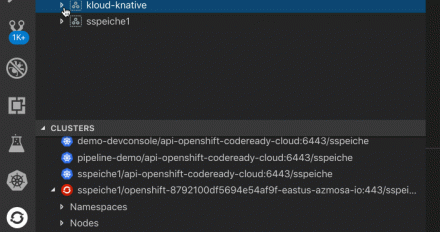
What's new in OpenShift Connector -- experience the seamless inner-loop developer experience using VS Code for Red Hat OpenShift 4.2.

If you do not already have the oc command line tool, you can download the version corresponding to the OpenShift cluster you are using, from the Command Line Tools option under the help menu

How to sign and verify signatures of container images using podman and skopeo

We show the potential of project Thoth's infrastructure running in Red Hat Openshift and how it can collect performance observations.
In this article, we'll walk you through the steps necessary to access a MySQL database running in your OpenShift cluster.

A DevNation Live tech talk - Building freely distributed containers with open tools
The Red Hat OpenShift 4.2 release includes new developer-focused updates to the web console.

Red Hat CodeReady Containers 1.0 is now available with support for Red Hat OpenShift 4.2; learn more in these videos.


Deploy a 3-tier NodeJS app on OpenShift

We explain the basics of Red Hat Fuse container images and discuss how to reduce the size of the Fuse image.

Get a local OpenShift 4 environment for development with Red Hat OpenShift Local

Get a local OpenShift 4 environment for development with Red Hat OpenShift Local
This post outlines how to configure OpenShift 4.x to use Auth0 as an OAuth2 provider.

Build here. Go anywhere.
We serve the builders. The problem solvers who create careers with code.
Join us if you’re a developer, software engineer, web designer, front-end designer, UX designer, computer scientist, architect, tester, product manager, project manager or team lead.
 Ask AI