Developer Advocate
Cedric Clyburn
Cedric Clyburn (@cedricclyburn), Senior Developer Advocate at Red Hat, is an enthusiastic software technologist with a background in Kubernetes, DevOps, and container tools. He has experience speaking and organizing conferences including DevNexus, WeAreDevelopers, The Linux Foundation, KCD NYC, and more. Cedric loves all things open-source, and works to make developer's lives easier! Based out of New York.
Cedric Clyburn's contributions
Article
vLLM vs. SGLang: Choosing the right inference engine for your workload
Learn how to choose between vLLM and SGLang for production LLM inference by comparing PagedAttention, RadixAttention, and independent benchmark results.
Article
LLM quantization guide: How to do it, and how it helps
Learn how to reduce LLM memory footprint and costs with our guide on quantization schemes for inference engines

Article
How AI observability works with MLflow
Learn how AI observability works with MLflow, an open source tool that can trace an agentic query and find the root cause of discrepancies between AI assistant responses and dashboard data. This post discusses the practical value of tracing an agent and what MLflow adds to an observability stack.
 Video
Video
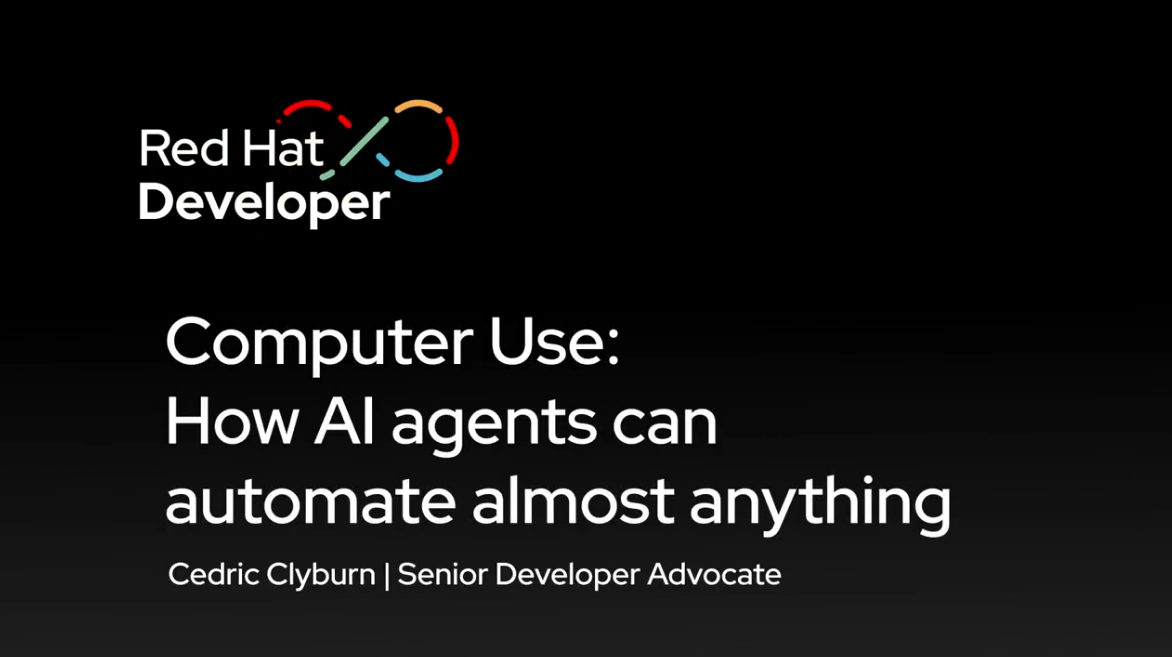
Computer Use: How AI Agents Can Automate Almost Anything
Agentic AI is cool, but how can we make it actually do things for us? Welcome to the world of Computer Use, where your model can take action for you on your desktop, and perform actions like typing, clicking, and more.
In this demo, we run an open source, natively multimodal model (Qwen3.6, 35B sparse MoE) locally on Mac using MLX, then connect it to Hermes, an AI agent with built-in guardrails for computer use. Watch it move a chess piece, apply a Photo Booth filter, and read a graph straight out of a research paper, all by seeing the screen and clicking, typing, and navigating like a human would. Everything runs on your own hardware through an OpenAI-compatible endpoint, so nothing you see or do ever leaves your machine.
#ComputerUse #AIAgents #RedHatAI #LocalLLM #PrivateAI #OpenSourceAI
Article
Computer use: How AI agents can automate almost anything
Learn how to set up local agentic AI computer use. Run quantized models like Qwen 3.6 with Hermes to automate desktop tasks on your own terms today.
Article
Run Claude Code locally with vLLM and OpenShift AI
Deploy a self-hosted AI coding assistant with vLLM and Red Hat OpenShift AI for privacy and operational independence.
Learning path

Article
Implement GPU-as-a-Service with Kueue and NVIDIA MIG
Learn how to implement GPU-as-a-Service on Red Hat OpenShift using Kueue, NVIDIA MIG, and a custom dashboard plug-in for self-service GPU resource booking.

vLLM vs. SGLang: Choosing the right inference engine for your workload
Learn how to choose between vLLM and SGLang for production LLM inference by comparing PagedAttention, RadixAttention, and independent benchmark results.

LLM quantization guide: How to do it, and how it helps
Learn how to reduce LLM memory footprint and costs with our guide on quantization schemes for inference engines

How AI observability works with MLflow
Learn how AI observability works with MLflow, an open source tool that can trace an agentic query and find the root cause of discrepancies between AI assistant responses and dashboard data. This post discusses the practical value of tracing an agent and what MLflow adds to an observability stack.
Computer Use: How AI Agents Can Automate Almost Anything
Agentic AI is cool, but how can we make it actually do things for us? Welcome to the world of Computer Use, where your model can take action for you on your desktop, and perform actions like typing, clicking, and more.
In this demo, we run an open source, natively multimodal model (Qwen3.6, 35B sparse MoE) locally on Mac using MLX, then connect it to Hermes, an AI agent with built-in guardrails for computer use. Watch it move a chess piece, apply a Photo Booth filter, and read a graph straight out of a research paper, all by seeing the screen and clicking, typing, and navigating like a human would. Everything runs on your own hardware through an OpenAI-compatible endpoint, so nothing you see or do ever leaves your machine.
#ComputerUse #AIAgents #RedHatAI #LocalLLM #PrivateAI #OpenSourceAI

Computer use: How AI agents can automate almost anything
Learn how to set up local agentic AI computer use. Run quantized models like Qwen 3.6 with Hermes to automate desktop tasks on your own terms today.
Run Claude Code locally with vLLM and OpenShift AI
Deploy a self-hosted AI coding assistant with vLLM and Red Hat OpenShift AI for privacy and operational independence.


Implement GPU-as-a-Service with Kueue and NVIDIA MIG
Learn how to implement GPU-as-a-Service on Red Hat OpenShift using Kueue, NVIDIA MIG, and a custom dashboard plug-in for self-service GPU resource booking.