Dipika Sikka's contributions
Article
Optimized support for Open NVIDIA Nemotron 3.5 Super VL
Double Nemotron 3.5 Super VL inference throughput on NVIDIA Hopper GPUs. Learn how FP8 quantization and DSpark speculative decoding boost speed and accuracy.

Article
Speeding up LLM inference with P-EAGLE in vLLM Speculators
Learn how P-EAGLE in Speculators v0.6.0 uses parallel drafting to reduce LLM latency. Train and deploy custom draft models with this step-by-step guide.
Article
Speculators v0.5.0: DFlash support and online training
Speculators v0.5.0 introduces DFlash support, enabling single-pass draft token generation with block diffusion for more efficient speculative decoding workflows. The release also adds unified online and offline training through vLLM’s native hidden states extraction system, improving training flexibility, version stability, and production readiness.
Article
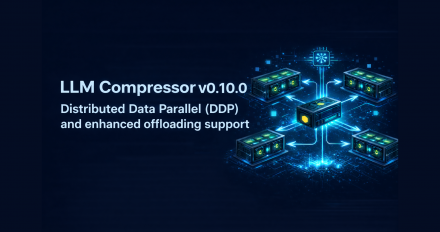
LLM Compressor v0.10: Faster compression with distributed GPTQ
LLM Compressor v0.10 introduces Distributed Data Parallel (DDP) for faster compression, memory management, and advanced quantization formats. Make model compression workflows more efficient for large language models.
Article
Accelerating large language models with NVFP4 quantization
Learn about NVFP4, a 4-bit floating-point format for high-performance inference on modern GPUs that can deliver near-baseline accuracy at large scale.

Article
LLM Compressor 0.9.0: Attention quantization, MXFP4 support, and more
Explore the latest release of LLM Compressor, featuring attention quantization, MXFP4 support, AutoRound quantization modifier, and more.
Article
Run Mistral Large 3 & Ministral 3 on vLLM with Red Hat AI on Day 0: A step-by-step guide
Run the latest Mistral Large 3 and Ministral 3 models on vLLM with Red Hat AI, providing day 0 access for immediate experimentation and deployment.
Article
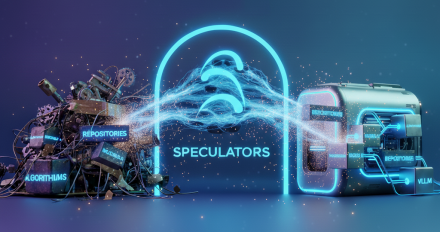
Speculators: Standardized, production-ready speculative decoding
Speculators standardizes speculative decoding for large language models, with a unified Hugging Face format, vLLM integration, and more.

Optimized support for Open NVIDIA Nemotron 3.5 Super VL
Double Nemotron 3.5 Super VL inference throughput on NVIDIA Hopper GPUs. Learn how FP8 quantization and DSpark speculative decoding boost speed and accuracy.

Speeding up LLM inference with P-EAGLE in vLLM Speculators
Learn how P-EAGLE in Speculators v0.6.0 uses parallel drafting to reduce LLM latency. Train and deploy custom draft models with this step-by-step guide.
Speculators v0.5.0: DFlash support and online training
Speculators v0.5.0 introduces DFlash support, enabling single-pass draft token generation with block diffusion for more efficient speculative decoding workflows. The release also adds unified online and offline training through vLLM’s native hidden states extraction system, improving training flexibility, version stability, and production readiness.

LLM Compressor v0.10: Faster compression with distributed GPTQ
LLM Compressor v0.10 introduces Distributed Data Parallel (DDP) for faster compression, memory management, and advanced quantization formats. Make model compression workflows more efficient for large language models.

Accelerating large language models with NVFP4 quantization
Learn about NVFP4, a 4-bit floating-point format for high-performance inference on modern GPUs that can deliver near-baseline accuracy at large scale.

LLM Compressor 0.9.0: Attention quantization, MXFP4 support, and more
Explore the latest release of LLM Compressor, featuring attention quantization, MXFP4 support, AutoRound quantization modifier, and more.
Run Mistral Large 3 & Ministral 3 on vLLM with Red Hat AI on Day 0: A step-by-step guide
Run the latest Mistral Large 3 and Ministral 3 models on vLLM with Red Hat AI, providing day 0 access for immediate experimentation and deployment.

Speculators: Standardized, production-ready speculative decoding
Speculators standardizes speculative decoding for large language models, with a unified Hugging Face format, vLLM integration, and more.