AI
  • Get started with AI

    • Red Hat AI

      Accelerate the development and deployment of enterprise AI solutions.

    • AI learning hub

      Explore learning materials and tools, organized by task.

    • AI interactive demos

      Click through scenarios with Red Hat AI, including training LLMs and more.

    • AI/ML learning paths

      Expand your Red Hat OpenShift AI knowledge using these learning resources.

    • AI quickstarts

      Focused AI use cases designed for fast deployment on Red Hat AI platforms.

    • No-cost AI training

      Foundational Red Hat AI training.

  • Featured resources

    • Red Hat OpenShift AI
    • Open source AI for developers
    • AI product application development
    • Open source-powered AI/ML for hybrid cloud
    • AI and Node.js cheat sheet

Red Hat AI Factory with NVIDIA

Red Hat AI Factory with NVIDIA is a co-engineered, enterprise-grade AI solution for building, deploying, and managing AI at scale across hybrid cloud environments.

Learn
  • Self-guided

    • Documentation

      Find answers, get step-by-step guidance, and learn how to use Red Hat products.

    • Learning paths

      Explore curated walkthroughs for common development tasks.

    • Guided learning

      Receive custom learning paths powered by our AI assistant.

    • See all learning
  • Hands-on

    • Developer Sandbox

      Spin up Red Hat's products and technologies without setup or configuration.

    • Interactive labs

      Learn by doing in these hands-on, browser-based experiences.

    • Interactive demos

      Click through product features in these guided tours.

  • Browse by topic

    • AI/ML
    • Automation
    • Java
    • Kubernetes
    • Linux
    • See all topics
  • Training & certifications

    • Courses and exams
    • Certifications
    • Skills assessments
    • Red Hat Academy
    • Learning subscription
    • Explore training
Build
  • Get started

    • Red Hat build of Podman Desktop

      A downloadable, local development hub to experiment with our products and builds.

    • Developer Sandbox

      Spin up Red Hat's products and technologies without setup or configuration.

  • Download products

    • Red Hat Enterprise Linux
    • Red Hat AI
    • Red Hat OpenShift
    • Red Hat Ansible Automation Platform
    • See all products
  • Featured

    • Red Hat build of OpenJDK
    • Red Hat JBoss Enterprise Application Platform
    • Red Hat OpenShift Dev Spaces
    • Red Hat Developer Toolset
  • References

    • E-books
    • Documentation
    • Cheat sheets
    • Architecture center
Community
  • Get involved

    • Events
    • Live AI events
    • Red Hat Summit
    • Red Hat Accelerators
    • Community discussions
  • Follow along

    • Articles & blogs
    • Developer newsletter
    • Videos
    • Github
  • Get help

    • Customer service
    • Customer support
    • Regional contacts
    • Find a partner

Join the Red Hat Developer program

Download Red Hat products and project builds, access support documentation, learning content, and more.

ConsoleDocsSupport Search
New For you

Recommended

We'll recommend resources you may like as you browse. Try these suggestions for now.

  • Product downloads
  • Cheat sheets
  • Red Hat Developer learning portal
  • Developer blog
  • E-books
  • Developer Sandbox
Log in

Get more with a Red Hat Developer account

  • Product downloads
  • Console access
  • Event registration
  • Training & trials
Explore more account benefitsLog in or register

A subscription may be required for some services.

Contact us

Create an Azure Red Hat OpenShift cluster in less than 5 minutes

March 4, 2022
Karan Singh
Related topics:
ContainersKubernetes
Related products:
Microsoft Azure Red Hat OpenShift (standard architecture)Red Hat OpenShift

    Microsoft Azure Red Hat OpenShift is a fully managed service of Red Hat OpenShift on Azure, jointly engineered, managed, and supported by Microsoft and Red Hat. Azure Red Hat OpenShift takes care of cluster and resource management, freeing developers to focus on developing new services (see Figure 1). The service offers a highly available control plane with fully managed master and application nodes—no virtual machines to operate and no patching required. Azure Red Hat OpenShift is backed by the expertise of site reliability engineers throughout the world.

    This tutorial (a simplified version of the official documentation) will show how you can easily create and launch an Azure Red Hat OpenShift cluster. 

    Figure 1: Components of Azure Red Hat OpenShift.
    Figure 1: Azure Red Hat OpenShift high-level architecture.


    [ Learning path: Getting started with Microsoft Azure Red Hat OpenShift (ARO) ] 

    Prerequisites

    To follow this tutorial, you need an Azure account and portal access. In addition:

    • Azure Red Hat OpenShift requires roleAssignment/write permission, so make sure your Azure user account has Microsoft.Authorization/roleAssignments/write permissions, such as User Access Administrator or Owner (Figure 2). More info can be found in the documentation for Azure built-in roles.
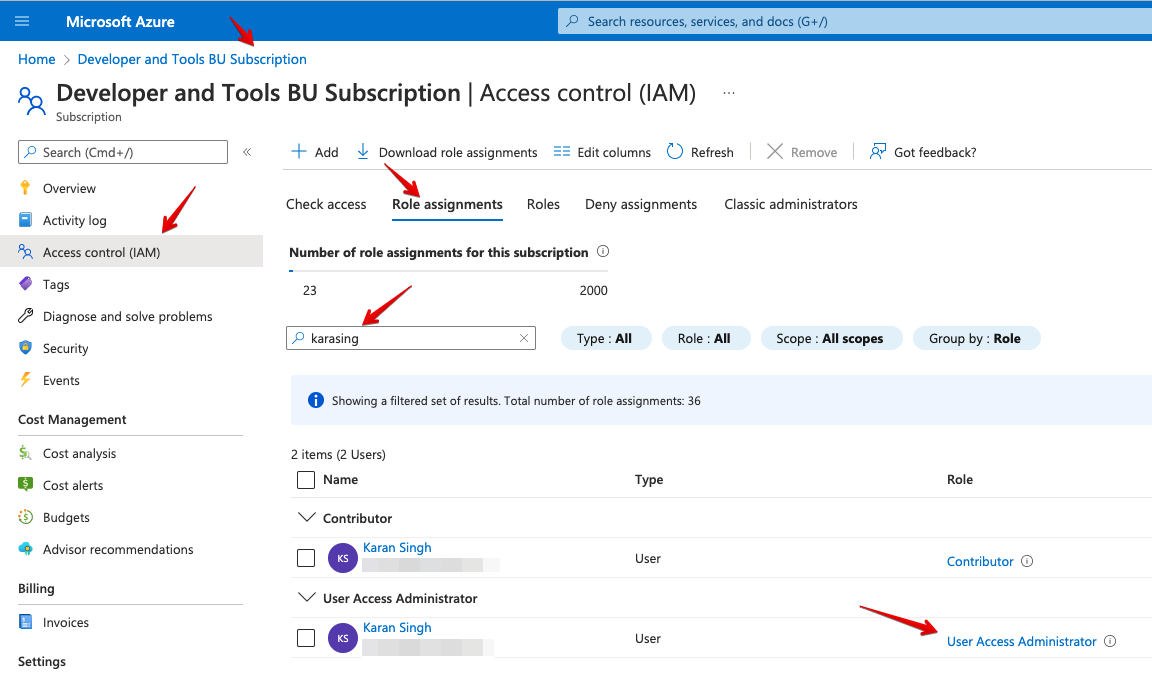
      Screenshot of Azure user account settings.
      Figure 2. Azure role assignment and user authorization.
    • Azure Red Hat OpenShift requires a minimum of 40 cores to create and run an OpenShift cluster. The default Azure resource quota for a new Azure subscription is 10 and does not meet this requirement. Therefore, you have to increase your quota from 10 to a minimum of 40. To request an increase in your resource limit, please consult the Microsoft document titled Increase VM-family vCPU quotas.

    Set up Azure Red Hat OpenShift

    Before setting up an OpenShift cluster, perform the following steps.

    1. Launch Azure Cloud Shell from Azure Portal (top right).

    2. Export some variables that we will often use in the rest of the tutorial. Substitute the values for the location and resource group that are appropriate for your environment:

      export LOCATION=centralindia
      export RESOURCEGROUP=ksingh-resource-group-india
      export CLUSTER=azureopenstack
    3. Verify the quota:

      az vm list-usage -l $LOCATION \
      --query "[?contains(name.value, 'standardDSv3Family')]" \
      -o table
    4. Get your subscription ID from Azure Portal:

      az account set --subscription <SUBSCRIPTION ID>
    5. Get the OpenShift pull secrets for your Azure Red Hat OpenShift cluster from cloud.redhat.com.

    6. Download the file with your pull secret and store it on Azure Cloud Shell under the name pull-secret.txt.

    Launch an Azure Red Hat OpenShift cluster

    Now you can create a cluster as follows.

    1. Register the resource providers:

      az provider register -n Microsoft.RedHatOpenShift --wait
      az provider register -n Microsoft.Compute --wait
      az provider register -n Microsoft.Storage --wait
      az provider register -n Microsoft.Authorization --wait
    2. Create a resource group:

      az group create --name $RESOURCEGROUP --location $LOCATION
    3. Create a virtual network:

      az network vnet create --resource-group $RESOURCEGROUP --name aro-vnet --address-prefixes 10.0.0.0/22
    4. Create two subnets in the aro-vnet network, one for the OpenShift control plane (master) and one for worker nodes:

      az network vnet subnet create --resource-group $RESOURCEGROUP --vnet-name aro-vnet --name master-subnet --address-prefixes 10.0.0.0/23 --service-endpoints Microsoft.ContainerRegistry
      
      az network vnet subnet create --resource-group $RESOURCEGROUP --vnet-name aro-vnet --name worker-subnet --address-prefixes 10.0.2.0/23 --service-endpoints Microsoft.ContainerRegistry
    5. Update the master node subnet network policy:

      az network vnet subnet update --name master-subnet --resource-group $RESOURCEGROUP --vnet-name aro-vnet --disable-private-link-service-network-policies true
    6. Create an Azure Red Hat OpenShift cluster with a default configuration:

      az aro create --resource-group $RESOURCEGROUP --name $CLUSTER --vnet aro-vnet --master-subnet master-subnet --worker-subnet worker-subnet --pull-secret @pull-secret.txt

    Connect to your Azure Red Hat OpenShift cluster

    You can start working in your cluster as follows:

    1. Get the URL and credentials of the OpenShift console (graphical user interface):

      az aro show --name $CLUSTER --resource-group $RESOURCEGROUP --query "consoleProfile.url" -o tsv
      az aro list-credentials --name $CLUSTER --resource-group $RESOURCEGROUP
    2. Install the OpenShift oc command-line client:

      cd ~
      wget https://mirror.openshift.com/pub/openshift-v4/clients/ocp/latest/openshift-client-linux.tar.gz
      
      mkdir openshift && tar -zxvf openshift-client-linux.tar.gz -C openshift echo 'export PATH=$PATH:~/openshift' >> ~/.bashrc && source ~/.bashrc
      
    3. Connect to OpenShift using oc:

      apiServer=$(az aro show -g $RESOURCEGROUP -n $CLUSTER --query apiserverProfile.url -o tsv) && oc login $apiServer -u kubeadmin -p

    Summary

    As you've seen in this tutorial, launching an Azure Red Hat OpenShift cluster from Azure Cloud Shell and aro CLI is simple and easy. I hope this article helps. See you next time!

    Last updated: September 20, 2023

    Related Posts

    • Deploying JBoss EAP with RHEL and Azure

    • It’s Time To Accelerate Your Application Development With Red Hat JBoss Middleware And Microsoft Azure

    • Deploying MicroProfile apps on Microsoft Azure using the Azure Open Service Broker

    • Introduction to the Red Hat OpenShift deployment extension for Microsoft Azure DevOps

    Recent Posts

    • A day in the life of an NVIDIA H100 on Red Hat OpenShift 5

    • Migrate BuildConfigs to builds for Red Hat OpenShift with one plug-in install

    • Run Red Hat Enterprise Linux CoreOS on NVIDIA BlueField DPUs

    • Agent harness engineering: Separating model capabilities from enforcement

    • What's new for developers in Red Hat Enterprise Linux 10.3 and 9.9

    What’s up next?

    Learn how to deploy an application on a cluster using Red Hat OpenShift Service on AWS. This learning path uses a pre-built application to allow you to become more familiar with OpenShift and Kubernetes features.

    Start learning
    Red Hat Developers logo

    Platforms

    • Red Hat AI
    • Red Hat Enterprise Linux
    • Red Hat OpenShift
    • Red Hat Ansible Automation Platform
    • See all products

    Build

    • Developer Sandbox
    • Developer tools
    • Interactive tutorials
    • API catalog

    Quicklinks

    • Learning resources
    • E-books
    • Cheat sheets
    • Blog
    • Events
    • Newsletter

    Communicate

    • About us
    • Contact sales
    • Find a partner
    • Report a website issue
    • Site status dashboard
    • Report a security problem

    Red Hat Developer

    Build here. Go anywhere.

    We serve the builders. The problem solvers who create careers with code.

    Join us if you’re a developer, software engineer, web designer, front-end designer, UX designer, computer scientist, architect, tester, product manager, project manager or team lead.

    Sign me up

    Red Hat legal and privacy links

    • About Red Hat
    • Jobs
    • Events
    • Locations
    • Contact Red Hat
    • Red Hat Blog
    • Inclusion at Red Hat
    • Cool Stuff Store
    • Red Hat Summit
    © 2026 Red Hat

    Red Hat legal and privacy links

    • Privacy statement
    • Terms of use
    • All policies and guidelines
    • Digital accessibility
    Ask AI