AI
  • Get started with AI

    • Red Hat AI

      Accelerate the development and deployment of enterprise AI solutions.

    • AI learning hub

      Explore learning materials and tools, organized by task.

    • AI interactive demos

      Click through scenarios with Red Hat AI, including training LLMs and more.

    • AI/ML learning paths

      Expand your Red Hat OpenShift AI knowledge using these learning resources.

    • AI quickstarts

      Focused AI use cases designed for fast deployment on Red Hat AI platforms.

    • No-cost AI training

      Foundational Red Hat AI training.

  • Featured resources

    • Red Hat OpenShift AI
    • Open source AI for developers
    • AI product application development
    • Open source-powered AI/ML for hybrid cloud
    • AI and Node.js cheat sheet

Red Hat AI Factory with NVIDIA

Red Hat AI Factory with NVIDIA is a co-engineered, enterprise-grade AI solution for building, deploying, and managing AI at scale across hybrid cloud environments.

Learn
  • Self-guided

    • Documentation

      Find answers, get step-by-step guidance, and learn how to use Red Hat products.

    • Learning paths

      Explore curated walkthroughs for common development tasks.

    • Guided learning

      Receive custom learning paths powered by our AI assistant.

    • See all learning
  • Hands-on

    • Developer Sandbox

      Spin up Red Hat's products and technologies without setup or configuration.

    • Interactive labs

      Learn by doing in these hands-on, browser-based experiences.

    • Interactive demos

      Click through product features in these guided tours.

  • Browse by topic

    • AI/ML
    • Automation
    • Java
    • Kubernetes
    • Linux
    • See all topics
  • Training & certifications

    • Courses and exams
    • Certifications
    • Skills assessments
    • Red Hat Academy
    • Learning subscription
    • Explore training
Build
  • Get started

    • Red Hat build of Podman Desktop

      A downloadable, local development hub to experiment with our products and builds.

    • Developer Sandbox

      Spin up Red Hat's products and technologies without setup or configuration.

  • Download products

    • Red Hat Enterprise Linux
    • Red Hat AI
    • Red Hat OpenShift
    • Red Hat Ansible Automation Platform
    • See all products
  • Featured

    • Red Hat build of OpenJDK
    • Red Hat JBoss Enterprise Application Platform
    • Red Hat OpenShift Dev Spaces
    • Red Hat Developer Toolset
  • References

    • E-books
    • Documentation
    • Cheat sheets
    • Architecture center
Community
  • Get involved

    • Events
    • Live AI events
    • Red Hat Summit
    • Red Hat Accelerators
    • Community discussions
  • Follow along

    • Articles & blogs
    • Developer newsletter
    • Videos
    • Github
  • Get help

    • Customer service
    • Customer support
    • Regional contacts
    • Find a partner

Join the Red Hat Developer program

Download Red Hat products and project builds, access support documentation, learning content, and more.

ConsoleDocsSupport Search
New For you

Recommended

We'll recommend resources you may like as you browse. Try these suggestions for now.

  • Product downloads
  • Cheat sheets
  • Red Hat Developer learning portal
  • Developer blog
  • E-books
  • Developer Sandbox
Log in

Get more with a Red Hat Developer account

  • Product downloads
  • Console access
  • Event registration
  • Training & trials
Explore more account benefitsLog in or register

A subscription may be required for some services.

Contact us

Integration blueprint example for mobile integration (part 8)

May 28, 2019
Eric D. Schabell
Related topics:
MicroservicesKubernetes

    In Part 7 of this series, we looked at details that determine how your integration becomes the key to transforming your customer experience. It started with laying out the process of how I've approached the use case by researching successful customer portfolio solutions as the basis for a generic architectural blueprint. Let's continue looking at more specific examples of how these blueprints solve specific integration use cases.

    This article walks you through an example integration scenario showing how expanding the previously discussed details provides blueprints for your own integration scenarios.

    Blueprint scenario

    As mentioned before, the architectural details covered here are based on real customer integration solutions using open source technologies. The example scenario presented here is a generic common blueprint that was uncovered researching customer solutions. It's my intent to provide a blueprint that provides guidance and not deep technical details.

    This section covers the visual representations as presented, but it's expected that they'll be evolving visually over time. There are many ways to represent each element in this architectural blueprint, but I've chosen icons, text, and colors that I hope are going to make it all easy to absorb. Feel free to post comments at the bottom of this post or contact me directly with your feedback.

    Now let's look at the details in this blueprint and outline the solution.
    omnichannel customer experience

    Mobile integration

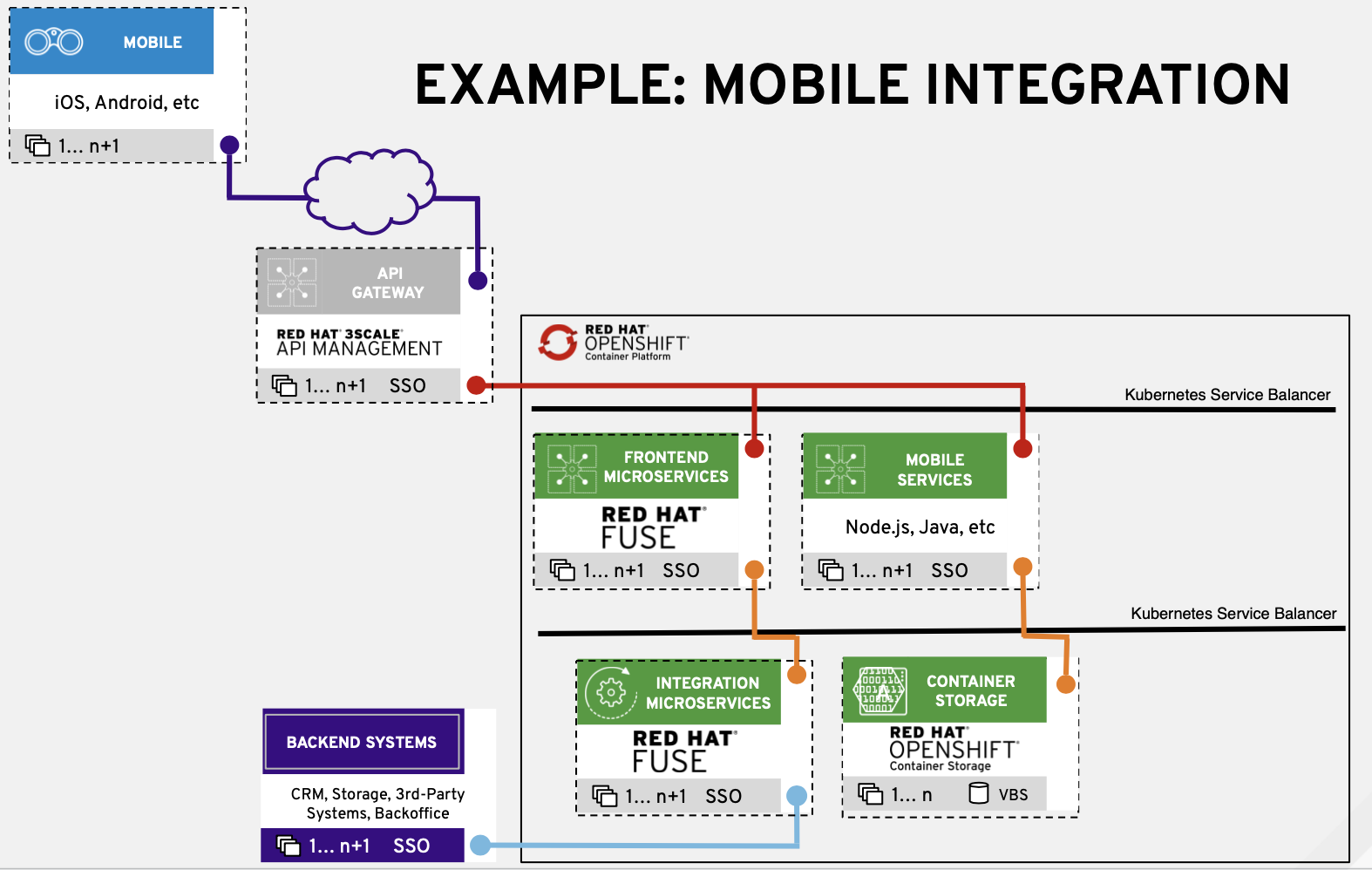
    The example blueprint shown in the figure titled Example: Mobile Integration outlines how to integrate mobile into your architecture. In this example, starting from the top, a mobile device is used to connect to your services through an API gateway. It's leveraging a group of microservices that provide frontend functionality. These frontend microservices are gathering data and information from the various organizational backend systems by working through integration microservices.

    Another group of microservices shows how the mobile services (that were discussed in generic terms in the previous article) are providing mobile-specific services such as push notifications, synchronization, and more. This shows how customers are using generic architectural integration concepts such as microservices to solve their reliance on specific mobile platform solutions.

    Storage services are not displayed in the diagram, instead container native storage is used for the various mobile services when maintaining application data, for mobile analytics, and any other persistence needs. There is a conscious effort here to keep this blueprint example as concise as possible; therefore, the integration of various potential backend systems has been simplified to a single representative box.

    What's next

    This overview covers the first example architecture blueprints on process integration for omnichannel customer experience use case.

    An overview of the series on omnichannel customer experience portfolio architecture blueprint can be found here:

    1. Part 1: How integration is key to customer experience
    2. Part 2: Common architectural elements for modern integration architectures
    3. Part 3: Integration of external application details
    4. Part 4: Integration of API management details
    5. Part 5: Integration of container platform essentials
    6. Part 6: Integration of storage services
    7. Part 7: Integration blueprint example for process automation
    8. Part 8: Integration blueprint example for mobile integration (this article)
    9. More example integration blueprints

    Catch up on any articles you missed by following one of the links above.

    Next in this series, we'll look at more specific integration architecture blueprints that tie in all the elements we've discussed as part of a specific case in an architecture for omnichannel customer experience.

    Last updated: May 23, 2019

    Recent Posts

    • A day in the life of an NVIDIA H100 on Red Hat OpenShift 5

    • Migrate BuildConfigs to builds for Red Hat OpenShift with one plug-in install

    • Run Red Hat Enterprise Linux CoreOS on NVIDIA BlueField DPUs

    • Agent harness engineering: Separating model capabilities from enforcement

    • What's new for developers in Red Hat Enterprise Linux 10.3 and 9.9

    Red Hat Developers logo

    Platforms

    • Red Hat AI
    • Red Hat Enterprise Linux
    • Red Hat OpenShift
    • Red Hat Ansible Automation Platform
    • See all products

    Build

    • Developer Sandbox
    • Developer tools
    • Interactive tutorials
    • API catalog

    Quicklinks

    • Learning resources
    • E-books
    • Cheat sheets
    • Blog
    • Events
    • Newsletter

    Communicate

    • About us
    • Contact sales
    • Find a partner
    • Report a website issue
    • Site status dashboard
    • Report a security problem

    Red Hat Developer

    Build here. Go anywhere.

    We serve the builders. The problem solvers who create careers with code.

    Join us if you’re a developer, software engineer, web designer, front-end designer, UX designer, computer scientist, architect, tester, product manager, project manager or team lead.

    Sign me up

    Red Hat legal and privacy links

    • About Red Hat
    • Jobs
    • Events
    • Locations
    • Contact Red Hat
    • Red Hat Blog
    • Inclusion at Red Hat
    • Cool Stuff Store
    • Red Hat Summit
    © 2026 Red Hat

    Red Hat legal and privacy links

    • Privacy statement
    • Terms of use
    • All policies and guidelines
    • Digital accessibility
    Ask AI